
Earlier this year, the Ottawa Heart Institute completed the first patient procedures with the commercial released version of the QDOT MICRO radiofrequency (RF) ablation catheter, a next-generation catheter that has demonstrated the ability to reduce total procedure time.i Reductions in procedure time are made possible by efficient and consistent lesion creation in conjunction with a simplified workflow. Using the very high power QMODE+™, it is the first catheter to enable ablation at up to 90 watts of RF power for up to four seconds in a temperature-controlled ablation mode, significantly improving ablation efficiency without compromising safety.
Atrial fibrillation (Afib or AF) is a type of irregular heart rhythm (arrhythmia). Arrhythmias are due to electrical signal disturbances of the heart. Afib is the most common arrhythmia, affecting more than 200,000 Canadians. The risk of developing atrial fibrillation increases with age and with other risk factors such as diabetes, high blood pressure and underlying heart disease. The main complications of atrial fibrillation are stroke and heart failure.1 Drug therapy is the most common treatment for Afib however it is sometimes ineffective or not well tolerated, and thus catheter ablation may be a recommended treatment option. Catheter ablation is associated with reductions in AF burden, AF-related complications as well as significant improvement in patient quality of life, with studies showing improvements of more than 50 percent.2,3,4
The first procedures with QDOT MICRO since receiving Health Canada approval took place at the Ottawa Heart Institute on April 3rd, 2023. “The most important advantage is improving the safety of catheter ablation procedures for atrial fibrillation without affecting the success rates of this procedure. Shorter procedures can help reduce wait time for catheter ablation and is an additional important and meaningful benefit of this new technology,” said Girish Nair, MBBS, MSc, director of the cardiac electrophysiology and arrythmia service at the UOHI, who performed the successful patient procedure earlier this month. “As the first in North America to perform the procedure using this technology, as an approved product, the University of Ottawa Heart Institute is leading the way in treating cardiac arrhythmias and collaborating with industry partners to improve patient care.”
Biosense Webster VP of global strategic marketing, Jasmina Brooks, said: “Biosense Webster is committed to partnering with physicians and innovating new technology that helps diagnose and treat cardiac arrhythmias. With Health Canada approval and the first procedures completed for QDOT MICRO, we are proud to help meet electrophysiologists’ needs for a higher power catheter with improved control that can safely, effectively and efficiently restore patients’ heart rhythms.”

Left to Right: Sudip Ghate, Prachi Bagaria, Bhairvi Sharma, Caroline Galand, Melanie Fernandes, Jessica Ottery, Dr. Girish Nair, Donna Whibley, Ghassan Jissam, Lesley Hiel, Becky McDaniel
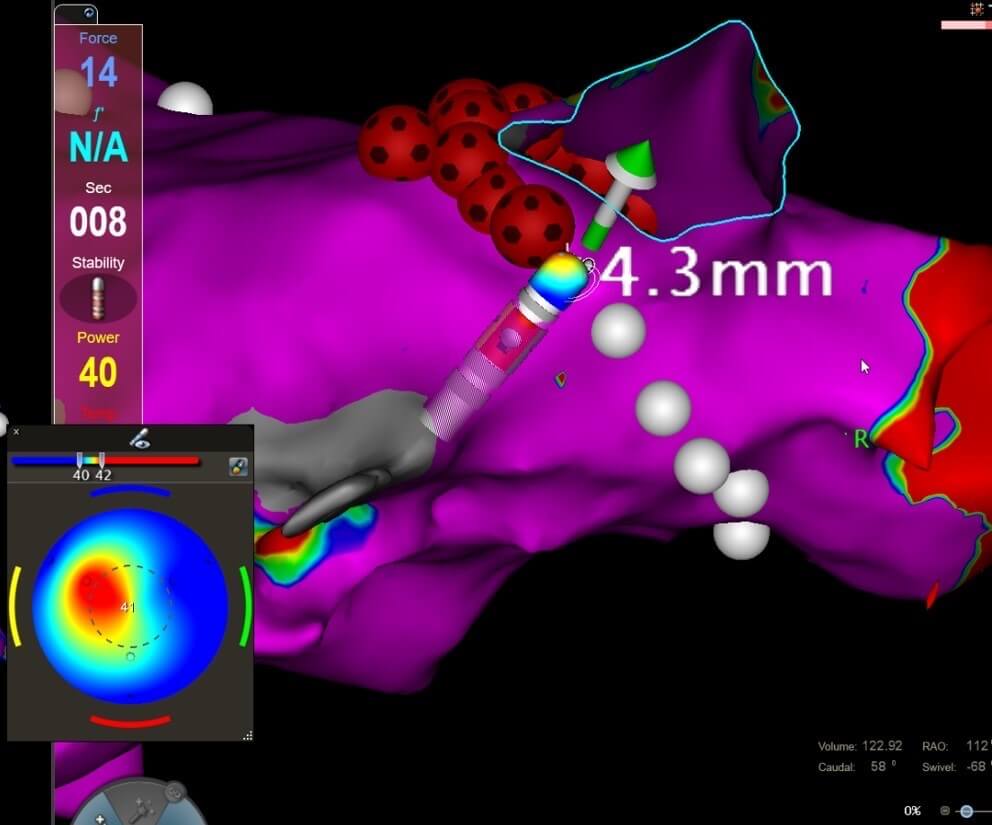
Image above is of Biosense Webster’s CARTO3® Mapping system being used to guide an Atrial Fibrillation ablation procedure using the NGEN® ablation generation and new QDOTMicro® Ablation Catheter. The QMode+ ablation tags indicate ablations completed using VHPSD ablations (very high power short duration ablations) with 90W for 4 seconds. The real time catheter beacon shows real time tip-tissue temperature.
References:
- Comparison based on a weighted average of the procedure time with QDOT MICRO™ Technology in QMODE (129.8 min; N = 42) and in QMODE+™ (105.2 min; N = 52),and the weighted average of the procedure time with irrigated, contact force RF catheters (202.8 min; 5 studies, N = 622).
- heartandstroke.ca Atrial Fibrillation
- Walfridsson, Håkan, et al. "Radiofrequency ablation as initial therapy in paroxysmal atrial fibrillation: results on health-related quality of life and symptom burden. The MANTRA-PAF trial." Ep Europace 17.2 (2015): 215-221.
- Blomström-Lundqvist, Carina, et al. "Effect of catheter ablation vs antiarrhythmic medication on quality of life in patients with atrial fibrillation: the CAPTAF randomized clinical trial." Jama 321.11 (2019): 1059-1068.
- Journal of Nursing: June 2019 - Volume 119 - Issue 6 - p 18 doi: 10.1097/01.NAJ.0000559795.09114.0b.
©2023 Johnson & Johnson MedTech, a Division of Johnson & Johnson (Canada) Inc. All Rights Reserved. CAN #245063-230405